How much does size and fit technology actually cost for Shopify stores? (2026 pricing guide)
Last updated on:
·
12 min read


Founder & CEO
If you sell bras or swimwear online, you have probably searched the Shopify App Store for a size tool and thought: hang on, why does one app cost $7 a month and another quote me $1,000?
We get asked this in almost every sales call. So rather than answer it one prospect at a time, here is the whole landscape, with real numbers, in one place. All prices are in US dollars, because that is how the Shopify App Store bills everyone. (Brarista bills in pounds sterling; dollar figures for our plans are approximate. They run from about $62 to $1,530 a month, and we will come back to why the range is that wide.)
Quick note on fairness: every figure below comes from each company’s own public listing or website, linked so you can check. Prices move, so treat this as a snapshot from August 2026.
The market is really three markets
The confusion exists because “size and fit tech” covers three completely different products that happen to share a search term. Size chart apps, AI fit finders, size recommendation engines, virtual fitting rooms, conversational commerce assistants: they all show up in the same search, at wildly different prices, doing wildly different jobs.
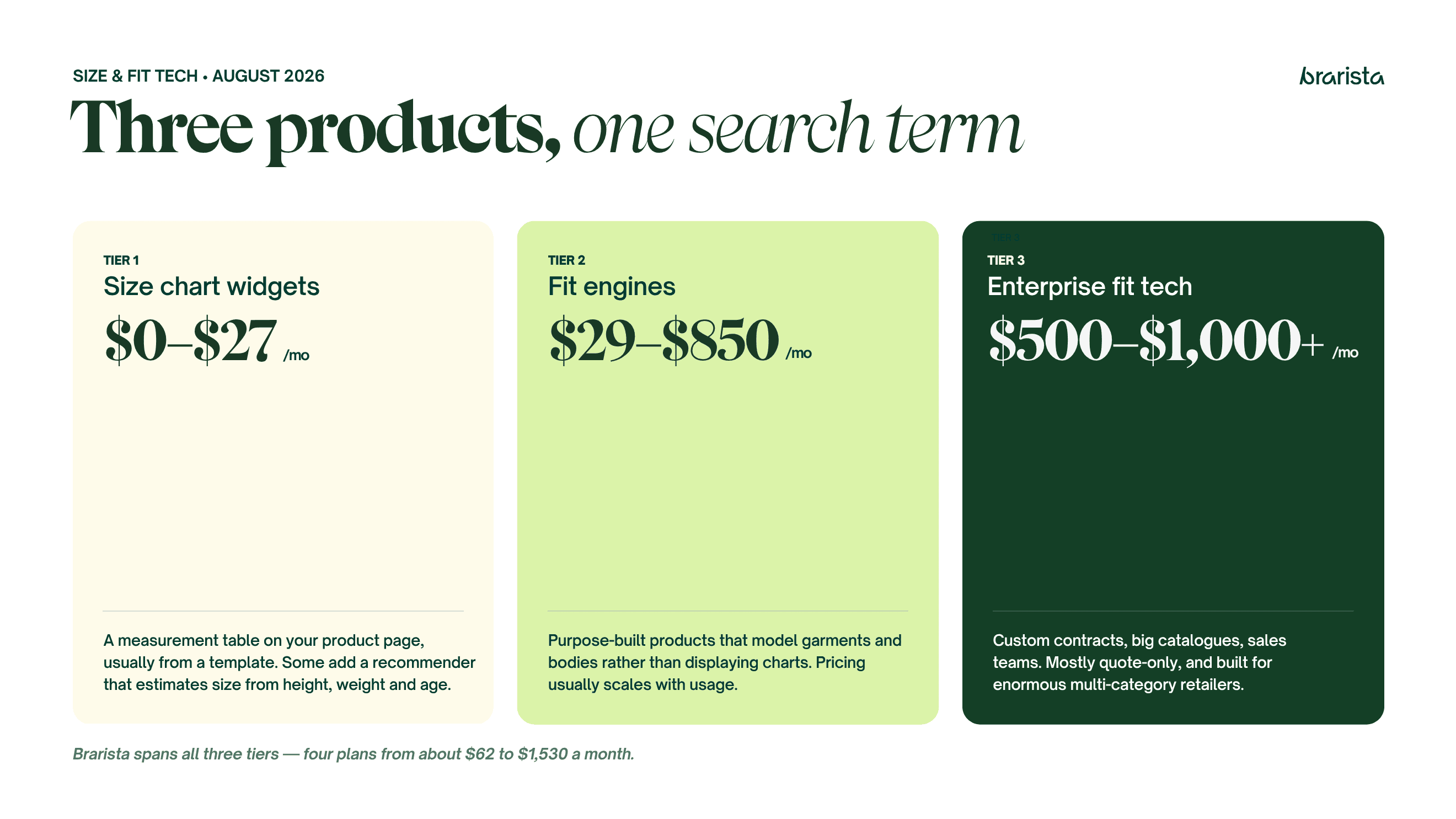
Tier 1: size chart widgets.
These display a measurement table on your product page, usually from a template. Some have added an “AI recommender” that asks a shopper their height, weight and age and estimates a size. They cost between nothing and about $27 a month.
Tier 2: fit engines.
Purpose-built recommendation products that model garments and bodies rather than just displaying charts. Published pricing runs from about $29 to $850 a month, usually with usage fees on top.
Tier 3: enterprise fit tech.
True Fit, Fit Analytics and friends. Custom contracts, big catalogues, sales teams. Mostly you have to ask for a quote, and the answer generally starts around $500 to $1,000 a month and climbs.Tier 1: the $7 apps, and what the headline price hides
Tier 1: the $7 apps, and what the headline price hides
Here is what the most visible Shopify size apps charge:
App | Pricing | Model |
|---|---|---|
Free, then $7.99 / $14.99 / $26.99 per month | Flat fee, plus order-based usage charges on higher tiers | |
Free, then $6.95 / $12.95 / $24.95 per month | Flat fee, with AI recommendations capped per tier (10 to 5,000 requests) | |
Free, then $9 / $12 / $19 per month | Flat fee; the $19 tier includes 100 size recommendations a month | |
$9.99 to $99.99 per month | Order-based, with per-order overage fees of $0.01 to $0.02 | |
Free to $149.99 per month | Visitor and try-on tiers (5,000 to 50,000 monthly visitors, 50 to 1,250 try-on sessions), plus $0.10 per extra try-on session | |
Free, then $5.99 / $11.99 per month | Flat fee, charts only | |
Free | Charts only |
Two honest observations, and neither is a criticism of these developers. They have built exactly what they charge for.
First, the “AI” is mostly a body-mass estimate. Ask a shopper their height, weight and age, look up an approximate body size, map it to the merchant’s chart. That is a reasonable heuristic for a t-shirt. It is genuinely the wrong tool for a bra, where band, cup, sister sizing and how a style is cut all interact, and where height and weight tell you almost nothing useful. Kiwi’s own site describes its recommender as machine learning body size prediction from simple questions like age and gender. Their words, not mine.
Second, the headline price is a starting price. Most of these apps meter something: orders, visitors, or recommendation requests. Cross the cap and the bill grows. One long-term Kiwi customer wrote in an App Store review that they went from paying around $5 to $7 a month to around $150 a month once order-based pricing kicked in. That is not a scandal, it is just usage pricing doing what usage pricing does. But it means the $7 app and the $150 app are sometimes the same app.

Tier 2: the fit engines
This is where products stop displaying charts and start modelling fit.
Product | Pricing | Model |
|---|---|---|
$125/month for the first 250 WAIR orders, then $0.50 per enabled order - returns excluded | Flat fee plus per-order usage | |
Free to install; charges apply after a trial period, quoted individually | Custom pricing, not published | |
$199 to $849 per month | Tiered by unique monthly users (2,000 to 12,000) | |
$35 / $125 / $250 per month, plus $0.15 per add-to-cart | Flat fee plus usage; annual plans from $750 remove the usage fee | |
$115 to $3,500 per month | Order-based (500 to 100,000 orders), 0.23$ per order to $0.03 per order over included limit |
Notice the pattern: once the product does real work per shopper, pricing moves from single digits to hundreds, and it scales with usage. WAIR’s $0.50 per assisted order and EasySize’s per-add-to-cart fee are good examples. On a decent month, the usage line can be as large as the subscription itself. And some, like Berlin-based SAIZ, do not publish pricing at all: free to install, then charges quoted individually after a trial, which is the enterprise sales model wearing an App Store badge.
Tier 3: the enterprise players
True Fit says its pricing starts at $1,000 a month, with Shopify tiers reported between roughly $499 and $999 depending on order volume. Fit Analytics, now owned by Snap, does not publish pricing at all. Neither do Sizebay, Bold Metrics or Fitle. MySize publishes a per-recommendation model from about $0.01 to $0.10 per recommendation plus an annual fee.
These are serious products with serious datasets. They are also generalists built for enormous multi-category catalogues, sold through sales teams, on contracts sized accordingly. If you are a lingerie or swim brand doing solid but not colossal volume, you are not really their customer, and the price reflects that.
So where does Brarista sit?
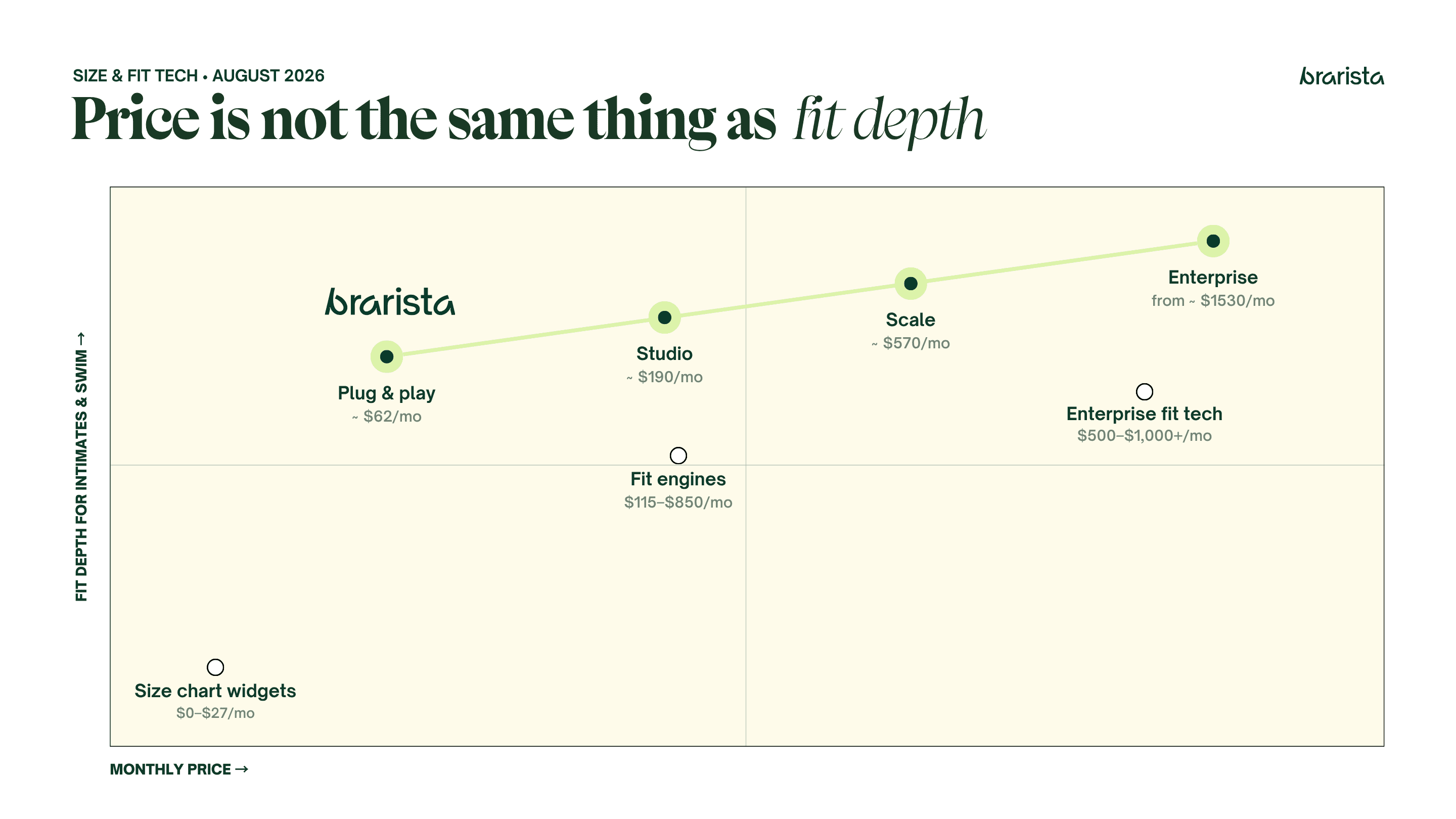
Across all three tiers, which sounds like a dodge until you see the ladder.
Brarista runs from about $62 a month for Plug & Play, through Studio at around $190 and Scale at around $570, up to Enterprise from roughly $1,530. Each tier includes a monthly allowance of shopper conversations, and the higher tiers add the things growing brands actually ask us for: a client success manager, deep-dive reporting, faster support.
What every tier shares is the thing neither end of the market sells: fitting methodology. I spent years as a professional bra fitter before founding Brarista, and the product encodes how a fitter actually works: band and cup logic, sister sizes, how a specific style runs, not a height-and-weight guess. Onboarding involves actual humans, because intimates sizing is where generic tools quietly fail and returns quietly pile up.
There is also a category difference worth naming. Brarista is conversational commerce, not a popup form. Shoppers talk to a fit assistant the way they would talk to a fitter in a store, and the same conversational AI handles styling and care questions, not just sizing. None of the chart widgets above do this, and the enterprise tools that come close price it accordingly.
The shortest version, the one I use in sales calls: size chart apps guess your size from height and weight. We fit you the way a fitter does.
A word on usage pricing, since I have just spent half this post warning you about it. Yes, we meter too: each plan includes a conversation allowance, with a per-chat rate beyond it. But there are two differences we think matter. First, we charge per conversation, not per order or per visitor, so you only pay when a shopper actually uses the fitting room, never for sales the tool played no part in. Second, you can switch on a hard cap: the assistant pauses gracefully at your allowance and your bill never exceeds your subscription. Bill certainty is a setting, not a hope.
The honest buying advice
If you sell hoodies and just need a measurement table on the page, install a free chart app and spend your money elsewhere. Genuinely.
If you sell bras, swim or anything where fit is the product, do the maths on two things before you choose: what a usage-priced tool will really cost at your volume, and what your fit-driven return rate is costing you today. In intimates, that second number is usually the one that decides it.

FAQs
How much does Brarista cost compared with apps like Kiwi Sizing?
How much does size and fit technology cost for a Shopify store?
Do cheap size apps work for lingerie and swimwear?
What is the difference between a size chart app and a fit recommendation engine?
Does Brarista charge usage fees?
Prices checked August 2026 against each product’s public Shopify listing or website. If you spot something out of date, tell us and we will fix it.
Related articles